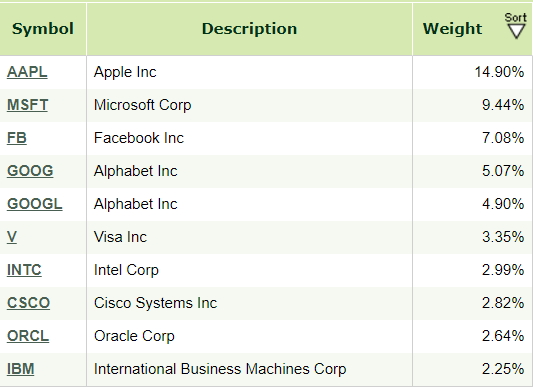
Most science and technology funds are passively-managed and capitalization-weighted.
All have done exceedingly well this year as the biggest of the big continue to gobble market share.
At what point do some governments may decide these monsters are too big for their pantalones and restrain them or tax them into unprofitability?
Here’s an interesting adjunct to ETF homogeneity that may fly under the political radar.
We used to think of tech stocks as those engaged in science and technology that would likely change the way we live, defend our nation, build things, transport ourselves, secure resources, and so on. Somewhere along the way the “science” part got moved into the sectors with which they deal – aerospace firms into the Industrials sector, those pursuing interesting avenues in alternative energy into the Energy Sector, new hardware for medical diagnostics into the Health Sector, etc.
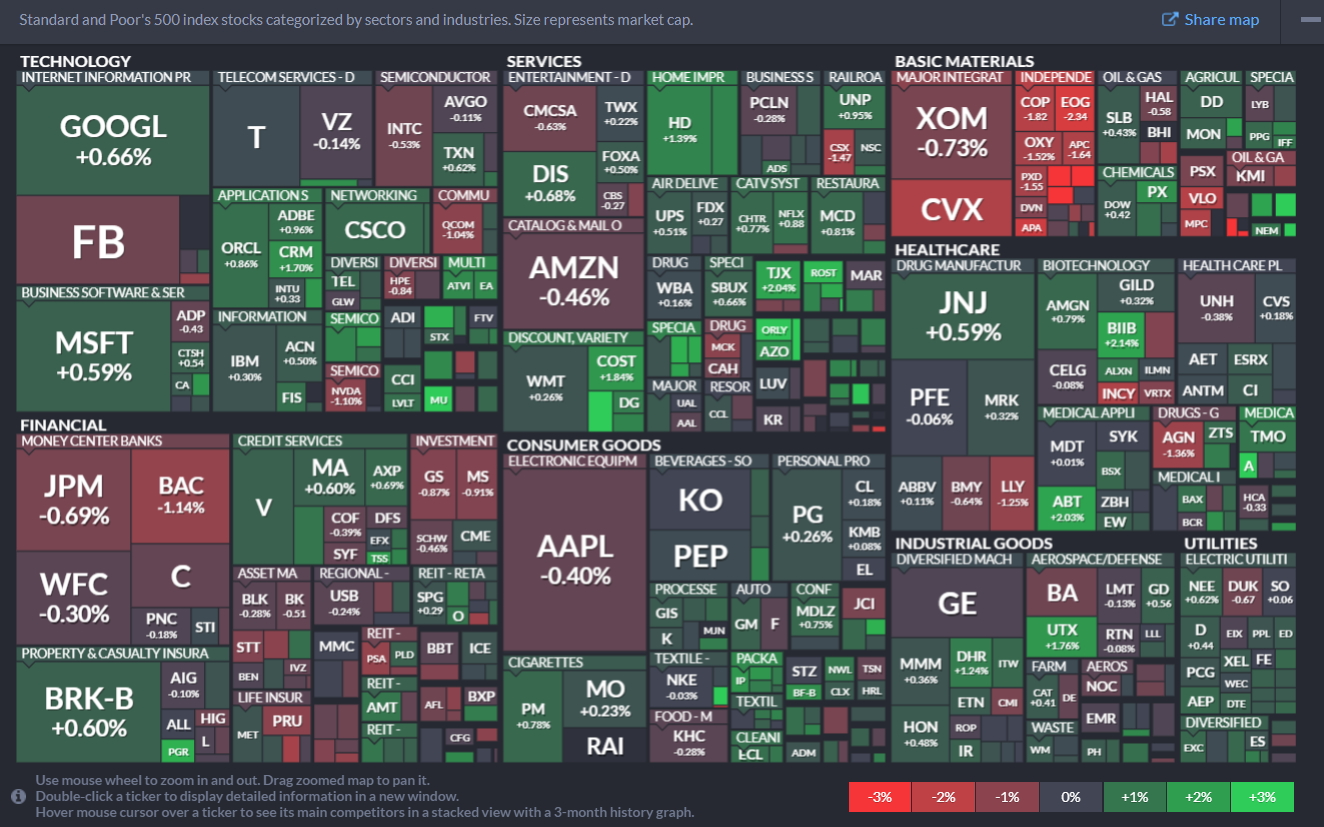
What Big Tech is now is mostly productivity and entertainment companies. Just take a look at the heat map of the S&P 500 below:
If you aren’t familiar with heat maps, they provide a visual overview of their subject, in this case the stocks of the S&P 500. This one is courtesy of www.finviz.com. If you visit its site you will find it to be interactive – you can zoom in to see each component by name within finviz’s sector choices. (finviz uses 8 sectors, the Sector SPDR ETFs uses 10, another source may use another number.)
While most sources show Amazon (NASDAQ:AMZN) (correctly) as catalog and mail order in the Services Sector, let’s face it – everyone thinks of it as a tech stock (and it is earning more money these days from providing data services and, who knows, maybe soon from organic kale and tofu as well.)
While most sources show Apple (NASDAQ:AAPL) (again, correctly) as electronic equipment in the Consumer Goods Sector, there can be no doubt that most investors say it is a tech company first and foremost.
Since, Apple, Microsoft (NASDAQ:MSFT), Facebook (NASDAQ:FB) and Amazon are the 4 most widely held stocks, at about 20% of the total S&P market capitalization, it should be no shock that they, along with Google (NASDAQ:GOOG) (NASDAQ:GOOGL), are the most widely held stocks in almost every “tech” ETF.
Some may quibble that Facebook is really a communication company or an entertainment company but given the parameters in my initial paragraph no one can dispute that Facebook has changed lives, some might argue for the better, some for the worse. At any rate it is certainly a diversion for many and an obsessive diversion for some. Just look at the heat map and GOOGL, FB, MSFT, AMZN and AAPL will leap out as the highest-market-cap stocks in the US markets today.
No, Netflix (NASDAQ:NFLX) isn’t in there. It’s too small to be considered among the top 10, but Goofma (GFMAA) just didn’t roll off the tongue as easily as FANG.
After a decade of experimenting with various options strategies, I have discovered a reliable approach to producing a steady 7% monthly return while protecting my investment. This strategy builds upon the principles of covered calls and calendar spreads, with a key twist. Traditional covered calls require significant capital and carry substantial downside risk if the stock price plummets. Calendar spreads, on the other hand, demand constant adjustments and have unlimited downside potential. The alternative strategy I've developed is a modified collar options strategy. It involves purchasing deep in-the-money call options with a longer expiration date and simultaneously selling at-the-money or slightly out-of-the-money call options with a shorter expiration date. Additionally, I buy out-of-the-money put options and sell way out-of-the-money put options with a longer expiration date. This approach has proven to be a reliable and consistent performer, offering a monthly return of over...
A lot of people have some capital or saved money but unfortunate they don't know what to do with it or basically don't know how to invest it because of lack of investment stratigiest knowledge or fear of losing their whole investment or some of it. Actually being an an investor needs a lot experience , knowledge , researching and patience. After so many years of investing and studying a lot of stratigiest from stocks , futures, bonds and stock options I have discovered Avery amazing and safe stratigie can generate almost 100% annual return on your investment . That stratigie based on buying different high quality stocks and sell Monthly CALL OPTIONS for these stocks AND Buying YEARLY PUT OPTIONS for these stocks at the same time as a hedging method incase of those stocks prices plunging down. That stratigie can assure you yearly income by selling those monthly call options despite of any changing of stock price. let us take an example : in 02/08/2016 apple stock...
Getting a business loan is a big challenge facing any small business because of tight lending requirements and standards by major banks. But having financing resources is a amain factor to keep your business running and growing. To get a business loan you need to consider these steps : 1- ask your self why you really need that loan and is it going to help your business to grow or to add more libilites to it and your self.you need to acknowledge the main purpose of that loan and always keep in your mind that you have to pay it back. 2- match the right loan with your business needs . 3-search for the right lender . Compare options base on terms and cost of each loan. 4- find out the qualifications to get that loan.know your credit score and revenue and match it with that loan. 5- apply for the loan and get all the documents needed to qualify for your business loan. www.google.com